After building ShutterCoWA‘s new website, we did what we do for every website that we launch – we monitor the Google rankings and make slight changes where necessary to ensure smooth sailing.
The issue we had with this website is that Google was continually swapping around the pages they had indexed for our main commercial-intent keywords.
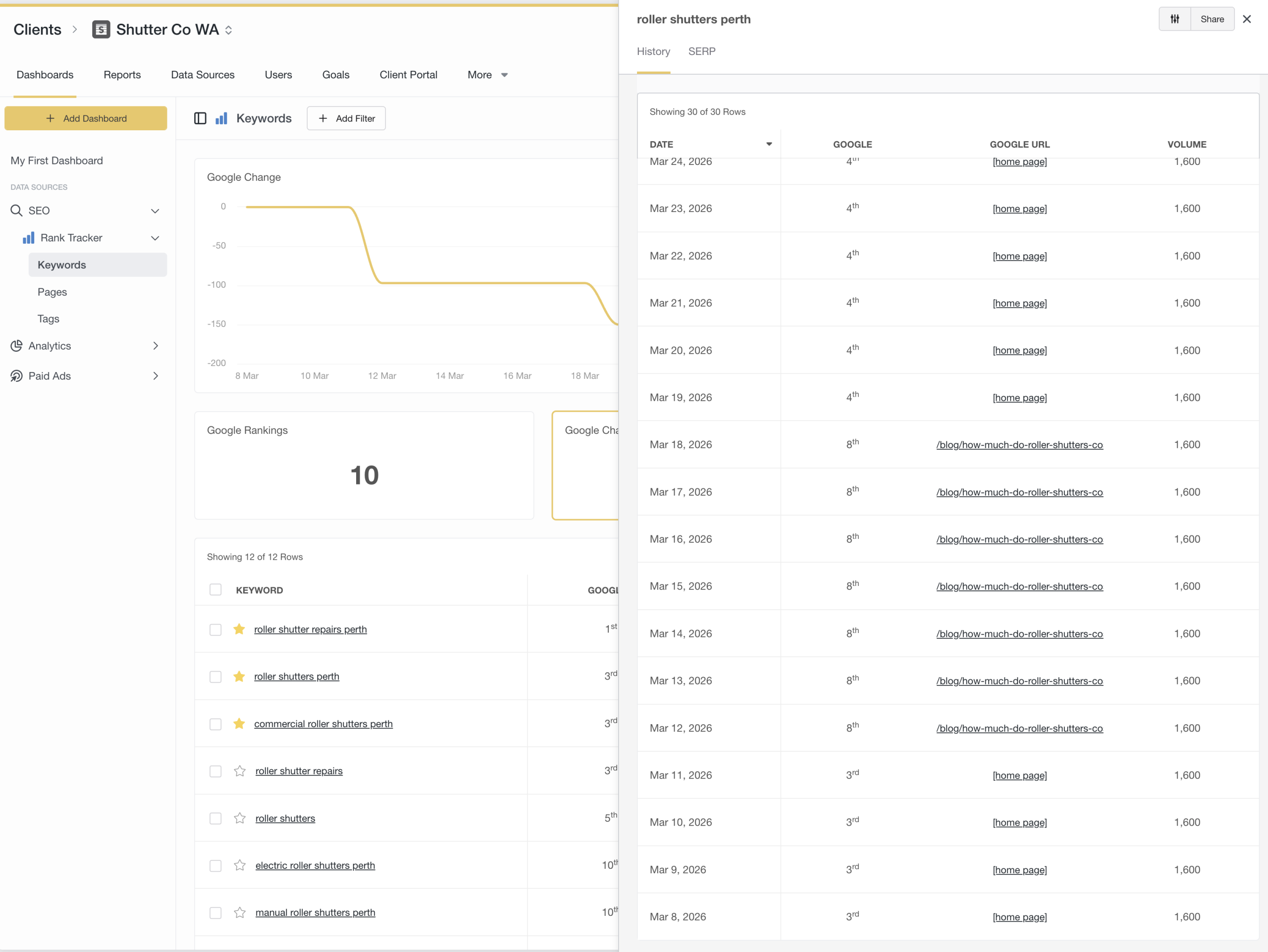
In order to fix this, we had to do a few things:
- 301 redirect the blog posts causing confusion to the target page
- Improve internal linking to indicate what the core page for this topic is
- Fix up other blog posts that closely matched commercial serach intent before they too caused issues
Had these issues gone un-noticed and not fixed, it would have severly impacted both their SEO long-term as well a drop in genuine enquiries (potentially resulting in tens of thousands of dollars worth of missed opportunities).
Blogs Have Been Marketed By Agencies
For years, blogging has been pushed as a “must-do” for Search Engine Optimisation.
More blogs = more keywords = more traffic… right?
Well…as the great saying in SEO goes; “it depends”.
In an age where SEO has become more complicated, a lot of agencies have resorted to populating blogs in order to justify their retainers.
The problem is that a lot of these agencies are just adapting to the market and don’t actually know what they’re doing.
Blogging done the wrong way can actively hold your website back
Let’s break down where things go wrong, and how to actually use blogging to strengthen your SEO instead of sabotaging it.
The Problem: Blogs Competing With Your Money Pages
One of the most common mistakes we see is businesses using blog posts to target their main commercial keywords.
Things like:
- “Plumber Perth”
- “Air Conditioning Installation Perth”
- “Roller Shutters Perth”
On the surface, it feels logical. More content around those keywords should help… right?
But here’s the issue.
When you create multiple pages targeting the same intent, you’re not strengthening your SEO – you’re splitting it.
Instead of one strong, clear signal to Google, you’re giving it multiple options and saying:
“You figure out which one matters.”
And often, Google gets it wrong.
What Actually Happens (And Why It Hurts Rankings)
When blog posts target your core service keywords, a few things tend to happen:
1. Keyword Cannibalisation
Your blog and your service page start competing against each other.
Neither becomes as strong as it could be because authority is split.
2. Diluted Relevance
Your main service page is supposed to be your strongest, most focused page for that keyword.
But if you’ve got multiple blogs loosely targeting the same topic, Google starts to lose confidence in which page is the “real” one.
3. The Wrong Page Gets Indexed
Sometimes Google will rank your blog instead of your service page.
Sounds fine… until you realise:
Blogs don’t convert nearly as well
They’re not structured to sell
They often miss key trust signals
So you end up with traffic but fewer enquiries.
4. Slower SEO Progress
Instead of building one powerful page that climbs rankings, you’re spreading effort across multiple weaker ones.
It’s the difference between one strong signal and multiple, mixed signals.
So… Should You Avoid Blogging?
Not at all.
Blogging is still incredibly powerful for SEO when it’s used properly.
The key is understanding the role blogs should play.
What Blogging Should Be Used For Instead
Rather than targeting your main commercial keywords, blogs should focus on:
Informational & Research-Based Searches
These are the types of queries people search before they’re ready to buy:
- “Is upgraded air conditioner ducting worth it for Perth summers?”
- “Why is my roller shutter stuck?”
- “How often should I service my car?”
These searches will show Google that you’re an authority on the topic, especially if you’re generating good user metrics.
You will likely attract traffic for a lot of out-of-area visitors – it doesn’t matter. These pages are not designed to sell, they’re designed to inform and position your business as an authority which helps life the trust of your entire business/domain.
Your blog content should act like support beams for your main service pages.
Each blog should:
- Target a specific question or niche topic
- Internally link back to your main service page
- Reinforce your authority around that service
Over time, this builds a clear structure:
- Service page: Sales page
- Blogs: Supporting content
The Real SEO Play: Topic Clusters
This is where things start to click.
Instead of random blogs, you build a structured content ecosystem.
For example:
Main Page:
- Air Conditioning Perth
Supporting Blogs:
- How much does air conditioning cost in Perth?
- Split system vs ducted: what’s more suitable for Perth?
- 5 signs you need a new air conditioner
- How long does aircon installation take?
Each of these blogs links back to the main page.
Now, instead of competing pages, you’ve created a network that tells Google:
“This main page is the authority and all of this content supports it.”
Internal Linking Is Where the Magic Happens
A blog on its own doesn’t do much.
A blog that links strategically? That’s where SEO starts to compound.
Every supporting article should naturally guide users back to your core pages.
Not forced. Not spammy. Just logical.
For example:
If someone is reading about air conditioning costs, it makes perfect sense to direct them toward your installation service.
This helps users take the next step, passes SEO value to your main pages and reinforces page hierarchy in Google’s eyes
The Bottom Line
Blogging isn’t about pumping out content for the sake of it.
And it’s definitely not about chasing the same commercial keywords across multiple pages.
Done wrong, it creates confusion, weakens your rankings, and brings in the wrong kind of traffic.
Done right, it strengthens your entire website.
A Better Way to Think About Blogging
Your website should work like a well-structured sales system:
Core pages are built to rank and convert.
Blogs are built to educate, attract, and support.
When those two work together, everything becomes clearer:
- Clear signals to Google
- Stronger rankings for the pages that matter
- Better quality leads